The Double Jeopardy Clause of the Fifth Amendment to the U.S. Constitution provides that a person may not be tried again for the twice for the same crime once they are acquitted. This is known as "Double Jeopardy." Double jeopardy attaches to a charge after a jury is empaneled, a judge in a "bench trial" begins to hear evidence, a jury has made a decision, or if a person pleads guilty to the crime. The purpose of double jeopardy is to prevent the government from potentially abusing its power to repeatedly charge a person with the same crime, from the same set of facts, until they get the result they want. In practice, strict application of this principle in a criminal context may produce injustices. In England, several murderers went free because the needed evidence wasn't discovered until after their acquittal. The British Parliament responded by enumerating circumstances under which a retrial could be ordered (U.K. Criminal Justice Act 2003). Since the U.S. has a federal syste...
Read More
Political corruption is a term that broadly refers to acts by elected officials that benefit themselves at the expense of the country or their constituents. The Supreme Court has recently taken a much narrower view of the legal definition as only including acts using the official powers of public office or of attempting to influence others to use their official powers for personal gain. Political corruption can include bribery, extortion, cronyism, nepotism, parochialism, patronage, influence peddling, and graft. Corruption may facilitate other crimes such as money laundering, fraud or embezzlement or it may be subtler. More subtle forms of corruption may involve changing regulations to benefit a campaign donor or providing access to decision makers in exchange for patronizing a business owned by someone related to a politician.
Read More
Executive privilege is a kind of legal immunity enjoyed by the sitting President of the United States. This privilege allows the president (and only the president) to withhold information from Congress and the public. While not written in the Constitution, this privilege is derived from an interpretation of the constitutional separation of powers doctrine and the supremacy of each branch of government over the other in their own sphere. Presidents have claimed executive privilege to ensure executive branch officials can speak confidentially and candidly regarding their responsibilities in office. However, the Supreme Court's decision in United States v. Nixon found that the president's ability to invoke the privilege is "qualified" (as opposed to absolute), meaning that it must be justified and is subject to limitation. Usually, the privilege protects only that information that protects military, diplomatic or sensitive national security secrets. Those who assert executive privil...
Read More
The word "emoluments" is construed broadly to mean any kind of benefit, profit or advantage. The Foreign Emoluments Clause (Article 1, Section 9, Clause 8) prohibits any officer of the United States from accepting gifts from foreign states without the consent of Congress. The Domestic Emoluments Clause (Article 2, Section 1, Clause 7) prohibits a President from receiving additional emoluments of any kind from the United States or individual states, other than his or her compensation. Its original intent was to avert Congressional legislators and state elected officials from seeking favor by bribing the President. The threat of corruption was of deep concern to the Framers of the Constitution. The Framers understood that a President could abuse his or her powers for financial gain at the expense of national interests. In an attempt to curtail this threat, the Framers adopted the Emoluments Clauses which prohibits federal officials from accepting items of value from foreign or s...
Read More
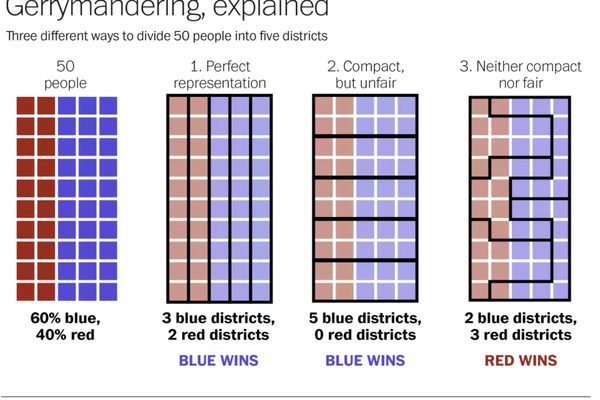
washingtonpost.com/wonkblog - Adapted from Stephen Nass
Gerrymandering is the practice of dividing a state or county into electoral districts so as to give one political party a majority in many districts while concentrating the voting strength of the other party into as few districts as possible. The practice has been part of American politics since before our Constitution went into effect, but the term was coined in 1812 as a result of Massachusetts governor Elbridge Gerry's redistricting of the state. A newly drawn electoral district map reminded some observers of a salamander, and so the term "Gerry-mander" was born. In general, partisan gerrymandering is not illegal, but should it be? One of the most significant cases that the Supreme Court will decide this term, Gill v. Whitford, raises the issue of whether partisan gerrymandering can so distort citizens' voting power that it violates our right to "equal protection of the laws" pursuant to the Fourteenth Amendment of the Constitution. The plaintiffs in Gill are Wisconsin voters wh...
Read More
Puerto Rico is a commonwealth of the United States. However, in practice, Puerto Rico technically is not a commonwealth. A commonwealth is defined as a nation, state or other political unit where "supreme authority is vested in the people." (Source) While Puerto Rico has its own constitution, judiciary, legislature and governor, in a recent decision the Supreme Court determined that the ultimate source of sovereignty over Puerto Rico is the U.S. Congress (Source). People born in Puerto Rico are U.S. citizens, they pay into Social Security and Medicare, but they cannot vote for President and cannot vote on legislation in the U.S. Congress. Although Puerto Rico is a "commonwealth" on paper, the practical realities are far more complicated. (Source)
Read More
A block grant is a fixed sum of money granted by the federal government to a state government for a specific purpose and subject to certain provisions. The amount of money bestowed by the federal government is determined in advance and if the state's expenditures exceed that amount, they must use their own funds to make up the difference. The Graham-Cassidy healthcare bill proposes turning Medicaid funding into Block Grants, as opposed to the joint funding program currently in place. Under the current program the federal government and the states split the cost of Medicaid on a percentage basis. This percentage, known as the Federal Medical Assistance Percentage (FMAP), varies by state and ranges anywhere from 50% to 75% depending on the state's per capita income (and certain other criteria). Under the Graham-Cassidy proposal, states would receive a set amount of money at the beginning of the fiscal year regardless of the actual cost of the Medicaid program, leaving the state le...
Read More
Deferred Action for Childhood Arrivals (known as "DACA") is a program established by the Department of Homeland Security ("DHS") in 2012 that allows undocumented immigrants who were brought to the U.S. by their parents, as children, to avoid deportation by meeting certain stringent criteria. Specifically, to be eligible for DACA, immigrants had to be younger than 31 on June 15, 2012, arrived in the U.S. when they were younger than 16, and lived in the U.S. since 2007. The phrase "deferred action" is exactly what it sounds like-- DHS agrees to temporarily ignore someone's undocumented status and gives them the opportunity to apply for a work visa, which grants them temporary legal status like any other foreigner temporarily living in the U.S. for work. There is no direct path to legal resident status or citizenship for a DACA recipient and it can be revoked at any time. But deferred action provides a modicum of relief to people who have grown up in the U.S., gone to U.S. schools, ma...
Read More
Introduction The August recess for Congress is here, making it a critical time for you to engage with your elected officials. Representatives began their break on July 28, and the Senate a few days later on August 3. Congress will be back in session after the Labor Day weekend on September 5.This document will arm you with the information you need to ask challenging, hard-hitting questions of your representatives at town halls, meetings or other events. The RISE Stronger Policy Working Group Program has prepared for you overviews of key topics on the national agenda across a range of areas, including the economy and jobs; education; energy and the environment; ethics and open government; foreign policy and national security; healthcare; infrastructure and urban policy; justice and civil liberties; science and technology; and trade and development. These key issues are summarized with background information and relevant questions for you to ask, as well as additional resources for yo...
Read More
The United States of Resistance is a weekly industry newsletter sharing the top news from across the resistance. Please share with others! Sign up | Archived Newsletters
Ladies & Gents, We have a special counsel! And that's the way the cookie crumbled...seems to be an appropriate way to kick off this week's United States of Resistance digest. Your demands worked. We now have a s...